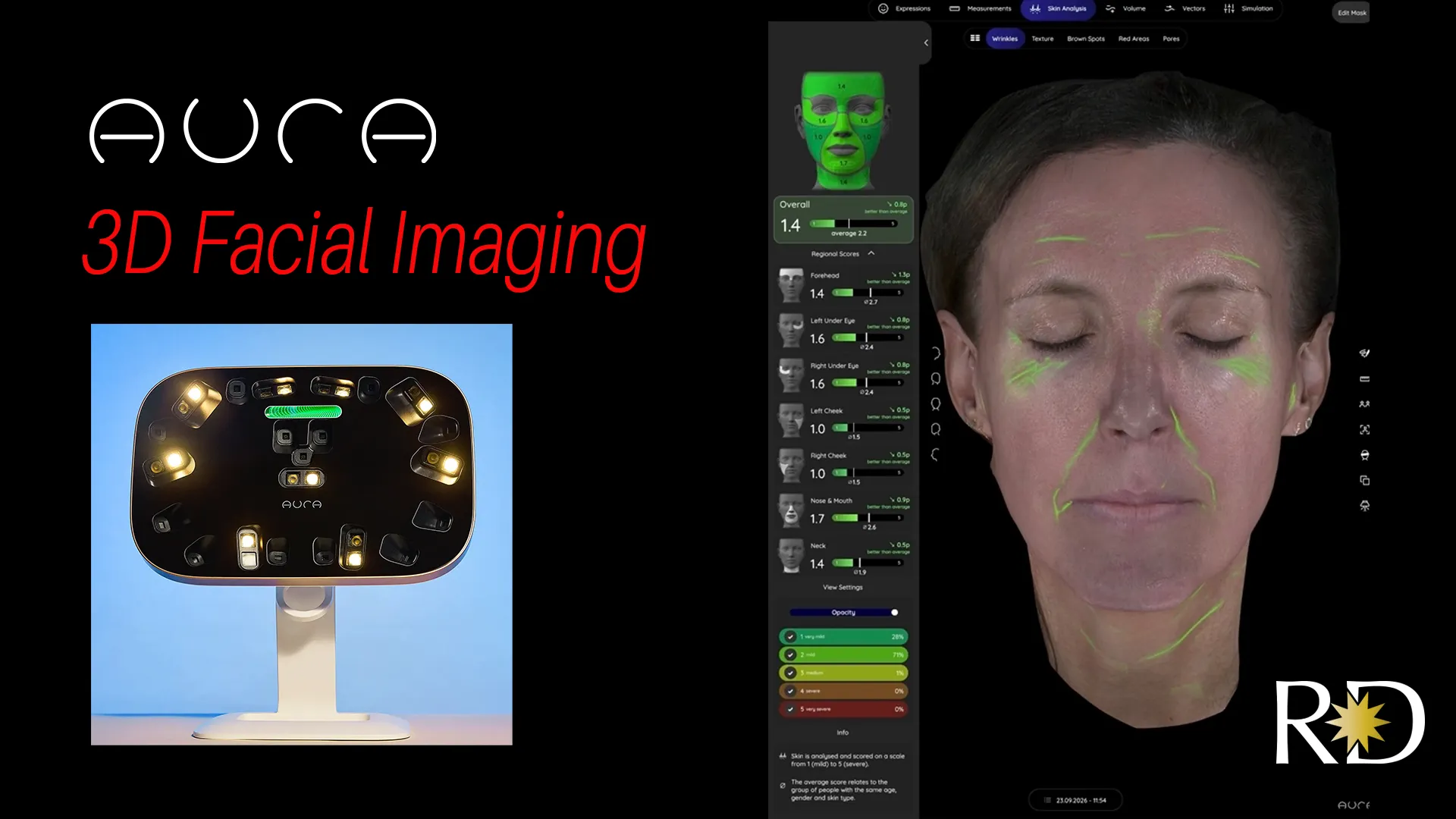
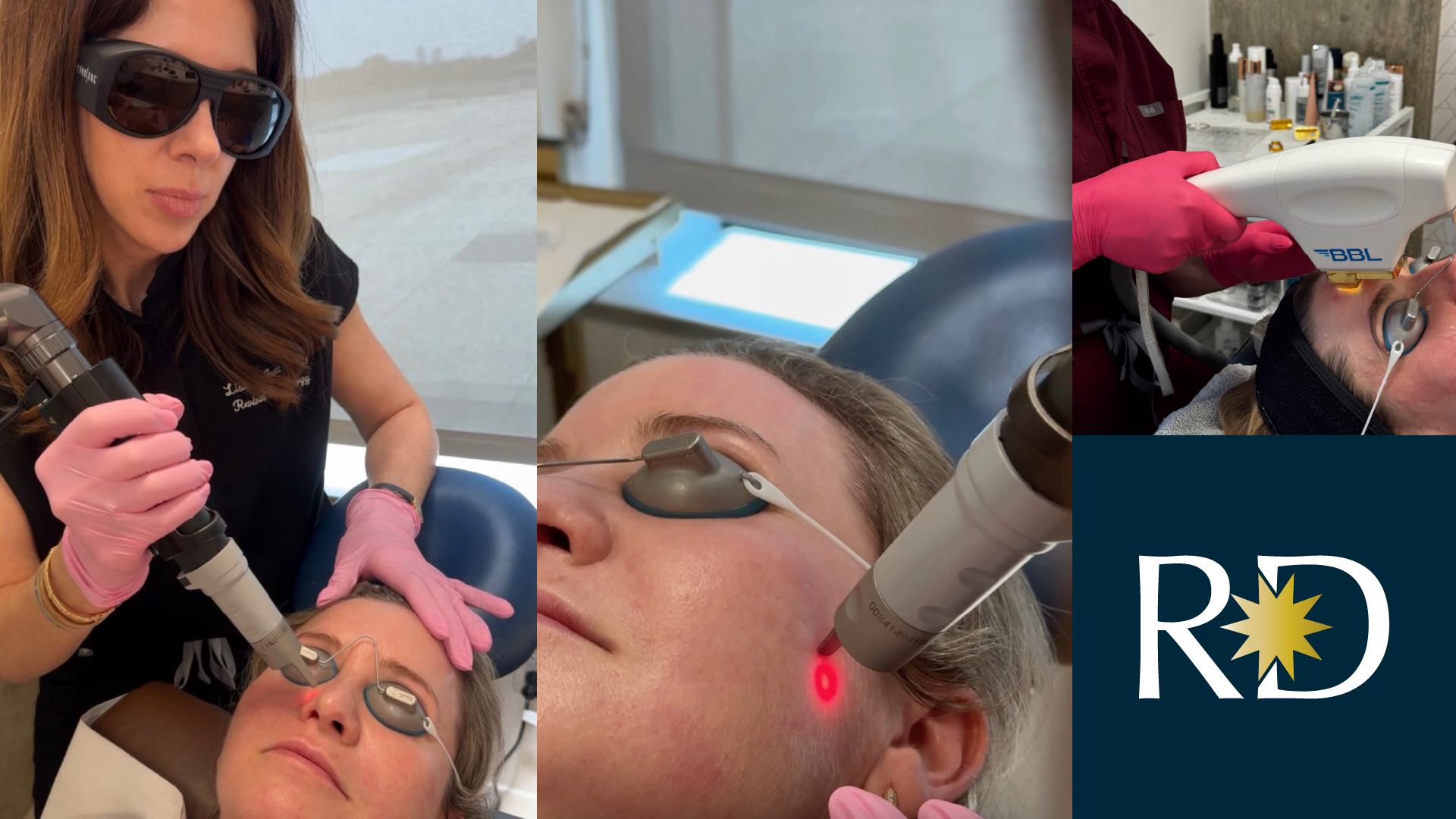
By Lisa Guidry Pruett, MD, FAAD, board certified dermatologist, featured in Dermatology Times in July 2026 on device-based acne care.
The breakout cleared months ago. The mark it left behind did not. That gap between healed acne and healed-looking skin is one of the most common reasons patients seek out a board certified dermatologist, and it is also where most treatment plans go wrong. No single device, serum or laser corrects every type of acne scar, and choosing the wrong one is the most frequent reason patients feel let down by their results. Effective acne scar treatment starts with correct identification. This article explains how to tell what is actually on the skin, and how to match it to an approach that has real evidence behind it.
This article is educational and is not medical advice. Individual evaluation by a physician is required to determine what is appropriate for any specific patient.

What Do Acne Scars Actually Look Like?
True acne scars are structural changes in the skin. They are either depressed (atrophic) or raised (hypertrophic or keloid), and the defining feature is that they alter the contour of the skin surface, not simply its colour. That distinction governs every treatment decision that follows.
Atrophic scarring is by far the most common presentation after inflammatory acne, and DermNet’s overview of acne scarring describes it as frequent among people with moderate to severe disease, particularly nodulocystic acne. A pooled analysis of prevalence studies, published in PMC, reported acne scarring in roughly 46 percent of patients with mild acne, 67 percent with moderate acne and 82 percent with severe acne. Scarring is not an unusual complication. It is a common one.
The four categories worth knowing:
- Icepick: narrow, deep, V-shaped tracts
- Boxcar: round or oval depressions with sharp vertical walls
- Rolling: broad, sloping, wave-like undulations
- Hypertrophic or keloid: raised, thickened tissue
The raised categories are often confused. As Cleveland Clinic explains, a hypertrophic scar stays within the borders of the original lesion, while a keloid grows beyond them.
There is a simple self-check. Run a fingertip lightly over the area. If the surface feels smooth and only the colour differs from the surrounding skin, it is very likely not structural scarring at all. That single test rules out a surprising number of cases, which brings up the most common misdiagnosis patients make about their own skin.
Are Red or Brown Marks After a Breakout Actually Scars?
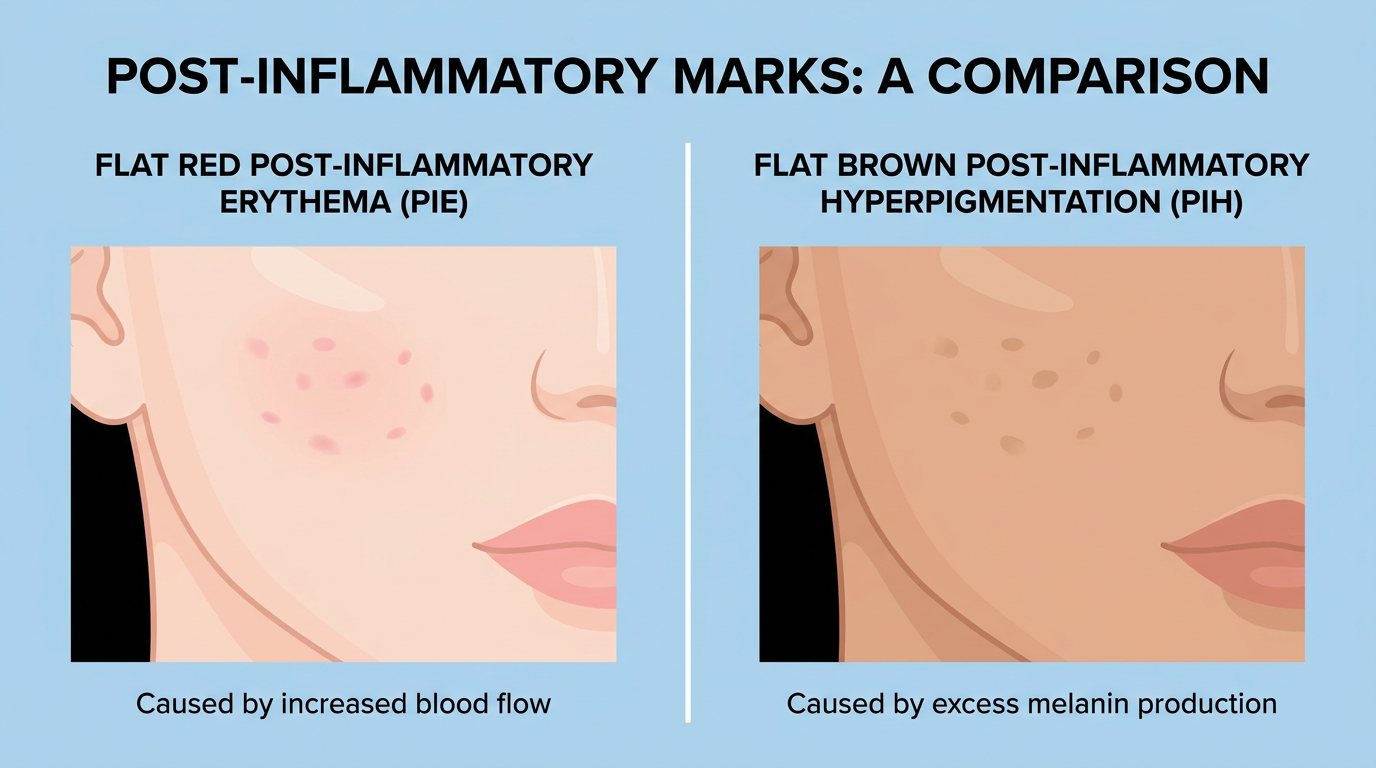
In most cases, no. Flat red, pink or brown marks left behind after a breakout are usually post-inflammatory erythema or post-inflammatory hyperpigmentation, and neither one is a true scar, because the contour of the skin is unchanged.
What is the difference between PIE and PIH?
The difference is vascular versus pigmentary. Post-inflammatory erythema, or PIE, results from dilated or damaged capillaries left behind by inflammation, and it presents as pink to red discolouration that may blanch under pressure. Post-inflammatory hyperpigmentation, or PIH, is driven by excess melanin deposited during the inflammatory response, and it presents as tan, brown or grey.
Why this matters practically: the two respond to completely different tools. Vascular discolouration responds to vascular and light-based approaches. Pigment responds to pigment-directed topicals, chemical peels and other pigment-directed options, and disciplined photoprotection. Treating one as though it were the other wastes months.
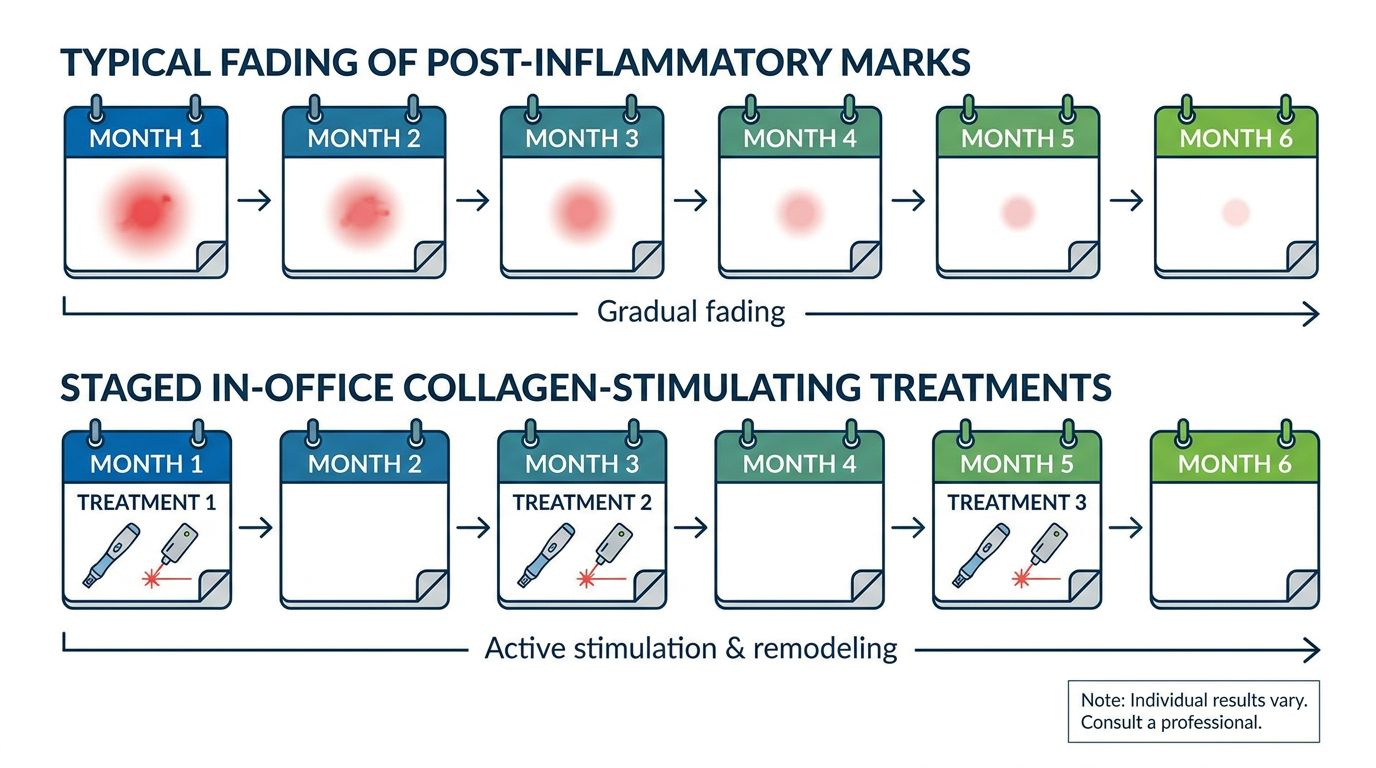
Both are frequently self-limiting and fade over weeks to months. Atrophic scarring does not. That is the practical dividing line between patience and intervention.
For PIH specifically, daily broad-spectrum sunscreen is not optional. Ultraviolet exposure actively drives and prolongs pigmentation, and in a city like Dallas, incidental year-round UV exposure is a genuine obstacle to clearing brown marks. Readers managing stubborn pigment may also find Revival Dermatology’s guide to melasma treatment in Dallas useful, since the photoprotection principles overlap considerably.
Revival Dermatology’s service list reflects this split. The practice describes its DermaV vascular laser as treating redness in the skin including scars and telangiectasias, and its customisable chemical peels as addressing concerns including hyperpigmentation.
When the surface genuinely is indented, the specific shape of that indentation determines what will and will not help.
What Are Icepick, Boxcar and Rolling Scars?
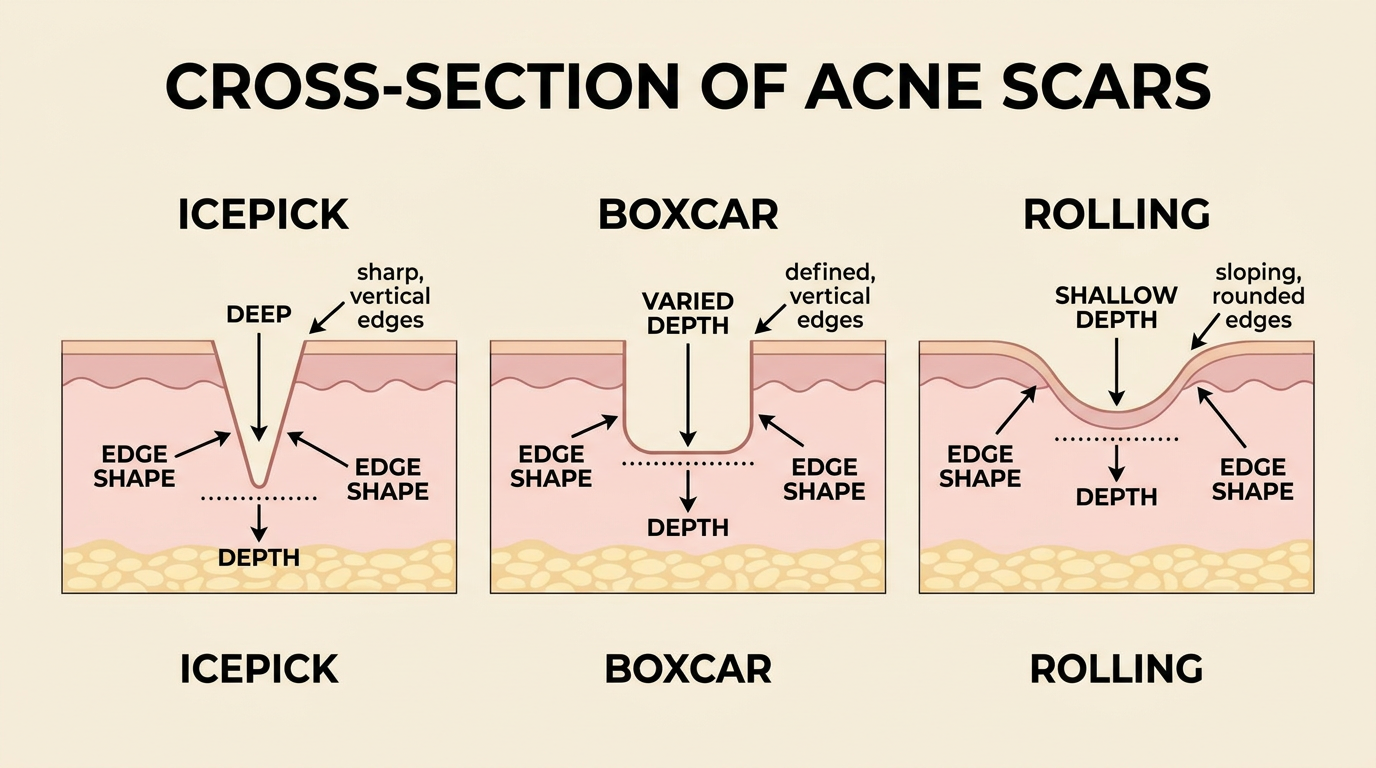
Atrophic acne scars come in three shapes, and each behaves differently in treatment because each represents a different depth and pattern of collagen loss. The review of effective treatments for atrophic acne scars published in PMCorganises treatment selection around exactly this three-subtype system.
Icepick scars are narrow, typically under 2mm across, V-shaped, and extend deep into the dermis. They are the most stubborn subtype for surface remodelling for a straightforward geometric reason: the defect is deeper than it is wide.
Boxcar scars are round or oval depressions, generally 1.5 to 4mm across, with sharply defined vertical edges and a U-shaped cross-section.
Rolling scars are the broadest, often exceeding 4 to 5mm, with sloping edges and an undulating surface. They are caused by fibrous tethering bands pulling the skin downward from beneath.
Most patients present with a mixture of subtypes across the same face. That single fact is why single-modality plans so often underperform.
| Scar type | What it looks like | What generally works | What generally does not work | Realistic expectation |
|---|---|---|---|---|
| Icepick | Narrow, under 2mm, deep V-shaped tract | The dermatology literature describes focal techniques such as subcision, TCA CROSS and punch excision for certain deep or tethered scars. A consultation is required to determine an individualised plan. | Surface-level resurfacing alone, most topicals | The most resistant subtype. Gradual, partial improvement over a planned course |
| Boxcar | Round or oval, 1.5 to 4mm, sharp vertical walls | Fractional resurfacing such as Halo, Deep Erbium resurfacing, Morpheus8 fractional radiofrequency | Vascular lasers, pigment-only topicals | Softening of edges and shallowing over a series |
| Rolling | Broad, over 4 to 5mm, sloping and tethered | SkinPen microneedling, Morpheus8, fractional resurfacing, often combined | Single sessions, surface exfoliants | Frequently the most responsive subtype to collagen induction |
| Hypertrophic or keloid | Raised and thickened tissue | Physician evaluation first. Management differs entirely from atrophic scarring | Ablative resurfacing without assessment, aggressive at-home treatment | Flattening and symptom relief rather than removal |
| PIE (red marks) | Flat, pink to red, smooth texture | Vascular and light-based approaches such as DermaV and BBL, photoprotection | Microneedling for the colour itself, harsh scrubs | Often fades on its own over months, treatment may accelerate it |
| PIH (brown marks) | Flat, tan to brown or grey, smooth texture | Pigment-directed topicals, chemical peels, rigorous daily sunscreen | Vascular lasers, physical exfoliation | Gradual fading over months, sun protection is decisive |
Patients evaluating radiofrequency microneedling can see documented results in the Morpheus8 before and after gallery.
Read across that matrix and one row exposes the single most widespread misconception in acne scar care.
Does Microneedling Work on Every Acne Scar Type?
No. A systematic review of randomised controlled trials on microneedling for atrophic scars reported that maximum improvement was seen in patients with rolling scars, followed by mixed scars and boxcar scars, with the least improvement in icepick scars. Microneedling is a genuinely effective tool. It is simply not equally effective on everything.
The mechanism explains the pattern. Microneedling is collagen induction therapy: controlled micro-injury triggers a wound-healing cascade that lays down new collagen and remodels the dermis. That process suits broad, sloping, tethered depressions extremely well. It suits a narrow tract running deep into the dermis considerably less well, because the treatment works across the surface while the defect extends downward.
Honesty about the evidence base matters here. The Cochrane review of interventions for acne scars, which assessed 24 randomised controlled trials involving 789 participants, concluded that no intervention can be recommended as first-line treatment, with most comparisons supported by low or very low quality evidence. That is not a reason to avoid treatment. It is a reason to be sceptical of anyone promising a single universal answer.
The literature also consistently indicates that combining modalities tends to outperform monotherapy, which is precisely why evaluation should precede device selection rather than follow it.
“The device matters far less than the match between the device and the scar. When a patient tells me a treatment did not work, the problem is usually that the right treatment was applied to the wrong scar type.” — Lisa Guidry Pruett, MD, FAAD
Revival Dermatology offers SkinPen microneedling and Morpheus8 fractional radiofrequency microneedling, and the practice notes that PRP can be combined with microneedling and laser skin resurfacing for enhanced benefit.
If the leading in-office device has clear limits, over-the-counter products deserve the same candour.
Do Topical Treatments or Accutane Get Rid of Acne Scars?
Topical actives are valuable for treating active acne and for improving post-inflammatory colour change, but no over-the-counter topical remodels the contour of an atrophic scar. Preventing new inflammatory lesions remains the single most effective way to prevent new scarring.
Does salicylic acid help acne scars?
Salicylic acid is a beta hydroxy acid that exfoliates and clears pores. It is useful in acne management and for surface texture, but it does not treat indented scarring.
Does benzoyl peroxide help acne scars?
Benzoyl peroxide is antibacterial and effective against inflammatory acne. It helps prevent the lesions that lead to scarring, though it does not correct scars that already exist.
Does niacinamide help acne scars?
Niacinamide supports barrier function and can assist with post-inflammatory pigmentation and redness. It has no structural remodelling effect on scar contour.
Does azelaic acid help acne scars?
Azelaic acid addresses inflammatory acne and pigmentation. Published work on 15% azelaic acid gel has examined its role in managing post-inflammatory erythema and hyperpigmentation. It does not alter scar contour.
Does Accutane get rid of acne scars?
Isotretinoin is a treatment for severe acne, not a scar-correction treatment. By controlling severe inflammatory disease, it prevents further scarring from developing. The timing of resurfacing procedures relative to isotretinoin use is a clinical decision that requires evaluation by a dermatologist.
The most productive use of topicals is upstream: controlling active breakouts in the first place. Revival Dermatology carries physician-selected lines including skinbetter, IS Clinical, Hydrinity and Pavise, and its skin care consultationsfocus on products with genuine science behind them.
Having established what will not work, the next question is the one patients actually ask first.
Are Acne Scars Permanent and How Long Do They Take to Fade?
True atrophic acne scars are permanent structural changes that do not resolve on their own, though their appearance can be meaningfully improved with appropriate treatment. Post-inflammatory red and brown marks are a different story entirely and commonly fade over weeks to months.
How long does it take for acne scars to fade?
PIE and PIH fade gradually over months, and consistent sun protection measurably accelerates the process. Structural scarring improves only through a course of treatment, and because collagen remodelling continues for months after a session, final results are not visible immediately.
How many sessions are usually needed?
Collagen-stimulating treatments are typically performed as a series rather than a single session. Revival Dermatology describes PRP for skin rejuvenation as a series of three treatments at monthly intervals, with optimal regeneration occurring over approximately three months, and notes that most DermaV patients require more than one treatment. Session counts for other devices depend entirely on the individual presentation and are established at consultation.
A systematic review of treatments for acne scarring reports ranges of improvement rather than clearance, and combination approaches generally outperform single-modality treatment. The honest framing is improvement, not eradication.
Patients weighing downtime can review what to expect before and after a procedure and documented patient results.
Timelines raise a practical follow-on question: when is the right moment to begin?
What Is the Best Acne Scar Treatment in Dallas and When Should Treatment Start?
There is no single best acne scar treatment. There is only the treatment best matched to the scar type, skin type and goals of the individual patient, which is why evaluation by a board certified dermatologist in Dallas should precede device selection.
Timing carries clinical weight. Ablative and fractional resurfacing increase photosensitivity and carry a risk of post-inflammatory hyperpigmentation, so the established clinical pattern is to schedule deeper resurfacing during lower-UV months. This rationale is clinical and editorial rather than promotional. It reflects how resurfacing interacts with sun exposure, nothing more.
That makes August an ideal month to consult and plan. Booking now allows a fall and winter treatment course to be mapped out in advance, so the series is already underway when the lower-UV window arrives.
Importantly, this does not mean waiting. Not every option is seasonally restricted. Revival Dermatology describes the Ultra Laser by Lutronic as safe for all skin types and even in sunny months, and BBL as a no-downtime treatment. A consultation determines what can reasonably begin immediately versus what is better scheduled later in the year, across the full range of cosmetic dermatology treatments.
Revival Dermatology is family owned by two board certified physicians and built around a boutique-style environment, a transparent and collaborative approach, and personalised plans rather than packaged protocols. The practice is located at 8201 Preston Rd, Ste 440, Dallas, TX 75225, open Monday to Friday, 8:30 to 4:30. Patients can schedule a cosmetic consultation directly.
Frequently Asked Questions About Acne Scar Treatment
Atrophic acne scars are structural changes and are permanent without treatment. Flat red and brown marks left after breakouts are not scars and usually fade over weeks to months.
No. Published literature describes improvement rather than eradication. Combination approaches generally outperform single treatments.
Neither is universally better. Evidence supports matching the modality to the scar subtype, and combination treatment is common in practice.
Cosmetic scar revision is generally not covered by insurance. Coverage questions are best directed to the practice, since circumstances vary by plan and by indication.
Treat active acne early rather than waiting for it to resolve on its own. Avoid picking and squeezing lesions, and apply broad-spectrum sunscreen daily.
Early evaluation is preferable, because controlling active inflammatory acne prevents additional scarring from forming. Patients can contact Revival Dermatology to arrange an assessment.
Conclusion
Effective acne scar treatment depends on correct identification, not on any single device. Flat red and brown marks are usually not scars at all. Atrophic subtypes respond differently from one another, and combination approaches planned by a dermatologist generally outperform single treatments. The realistic goal, supported by the published evidence, is meaningful improvement rather than erasure. Patients who understand that distinction tend to be the ones who end up genuinely satisfied with their results.
Plan an acne scar treatment course with Revival Dermatology
A cosmetic consultation is the step that identifies scar type and builds a personalised plan, which is what makes everything in this article actionable rather than theoretical. Consulting in August allows a fall and winter treatment course to be scheduled appropriately.
Book Appointment or view before and after results.
8201 Preston Rd, #440, Dallas, TX 75225
Phone 214.675.3227
Monday to Friday, 8:30 to 4:30Revival Dermatology blends passion for the practice with compassion for patients, delivering an elevated, personalised experience.