Staring in the Mirror, Searching for Answers
Most people have had this moment: standing in front of the bathroom mirror, tilting your chin toward the light, wondering why your skin looks the way it does today. Is that faint discoloration sun damage or just shadow? Is that fine line new, or just more noticeable lately? And if you did book a dermatology appointment, how would you actually know which treatment is right for you, or whether it worked?
For years, the answer depended almost entirely on a trained eye. A provider would look closely, ask a few questions, and make a recommendation based on experience and visual assessment. That has real value, but it leaves patients without much to hold onto.
Revival Dermatology, a family-owned, boutique dermatology practice in Dallas, has built its reputation on a different philosophy: treat the whole patient, explain the reasoning behind every recommendation, and never make someone feel like a number in a waiting room. That philosophy is exactly why Revival introduced Aura, a Swiss-made 3D facial imaging system, into its consultation process.
Aura is not a flashy add-on. It’s a precision instrument built on measurement technology from Hexagon, a company known globally for engineering some of the most accurate measurement systems in the world. When a patient sits down for a skin analysis at Revival, Aura gives both patient and provider the same detailed, data-rich view of the skin, down to fractions of a millimeter. That shared view changes the entire conversation: instead of a provider simply stating an opinion, both people are looking at the same evidence together.
Many readers researching this topic have already come across “VISIA skin analysis,” long one of the most recognized names in photographic skin imaging. Others are searching “skin analysis near me“ or “skin analysis Dallas,” looking for a practice with a more thorough, evidence-based approach before committing to treatment. This article explains what Aura is, what makes its 3D approach different from traditional imaging, what a Revival visit looks like, and who benefits most from this kind of precision analysis.

What Is Aura? Inside the Swiss-Made 3D Facial Imaging System
Aura was developed by Hexagon, a company that has spent decades building precision measurement systems used across aerospace, manufacturing, and construction in more than 50 countries. Hexagon didn’t enter aesthetics with a stock camera setup; it brought measurement engineering into a device built specifically to capture the human face with extraordinary accuracy, as detailed on Aura Reality’s official site.
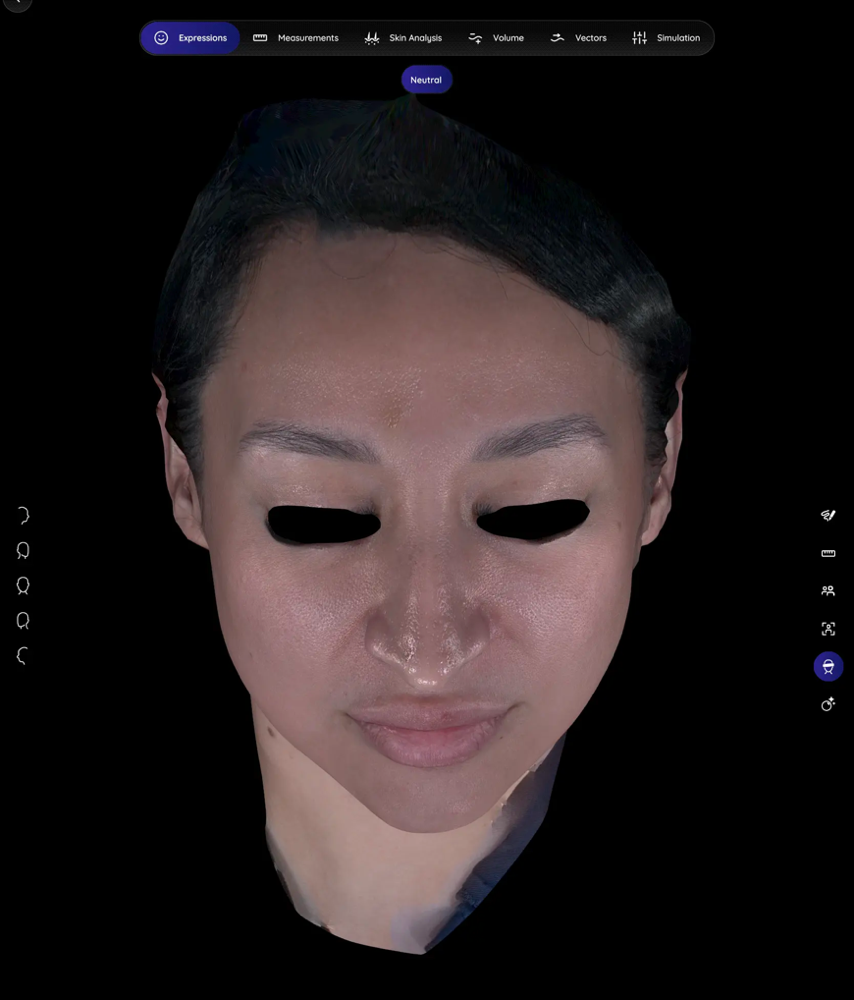
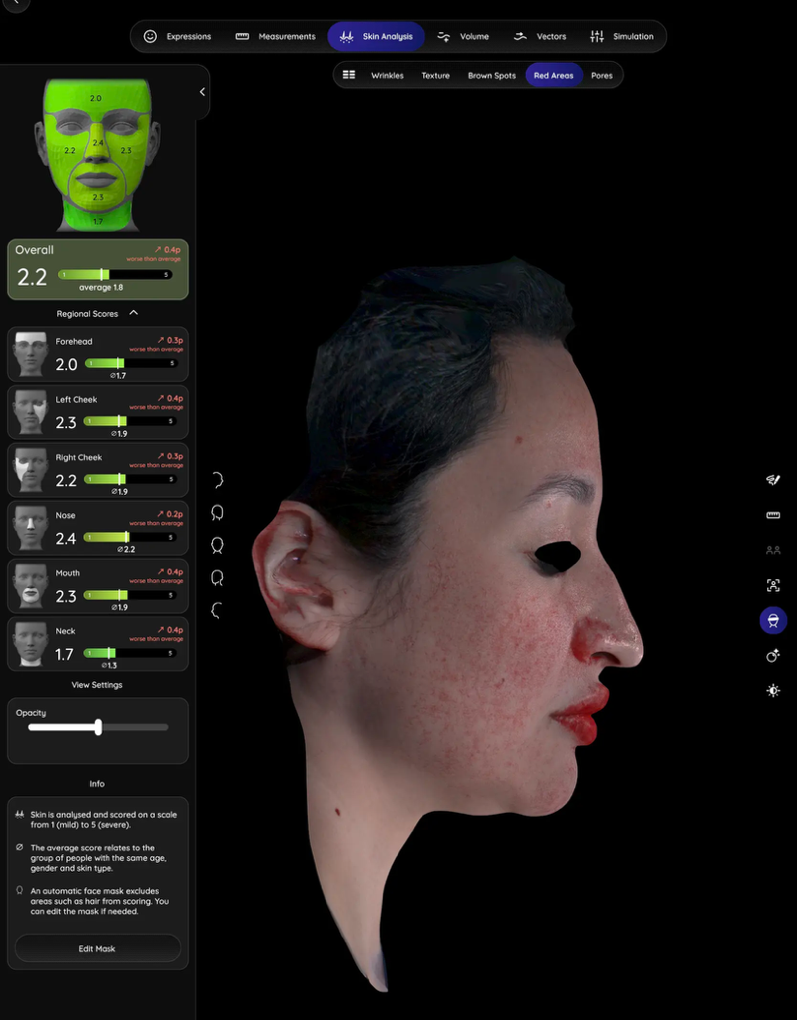
According to Aura’s technical specifications, the system uses 13 high-resolution cameras and 18 LED light units to capture a photorealistic 3D digital twin of a patient’s face and neck in about 0.2 seconds, generating roughly 575 megapixels of facial data at 0.1 millimeter accuracy, thinner than a sheet of paper.
That digital twin becomes a working clinical tool, analyzing:
- Wrinkles and fine lines across the face and neck
- Pores, including size and distribution
- Red areas, which can indicate vascular conditions, rosacea, or inflammation
- Brown spots, including sun damage and hyperpigmentation
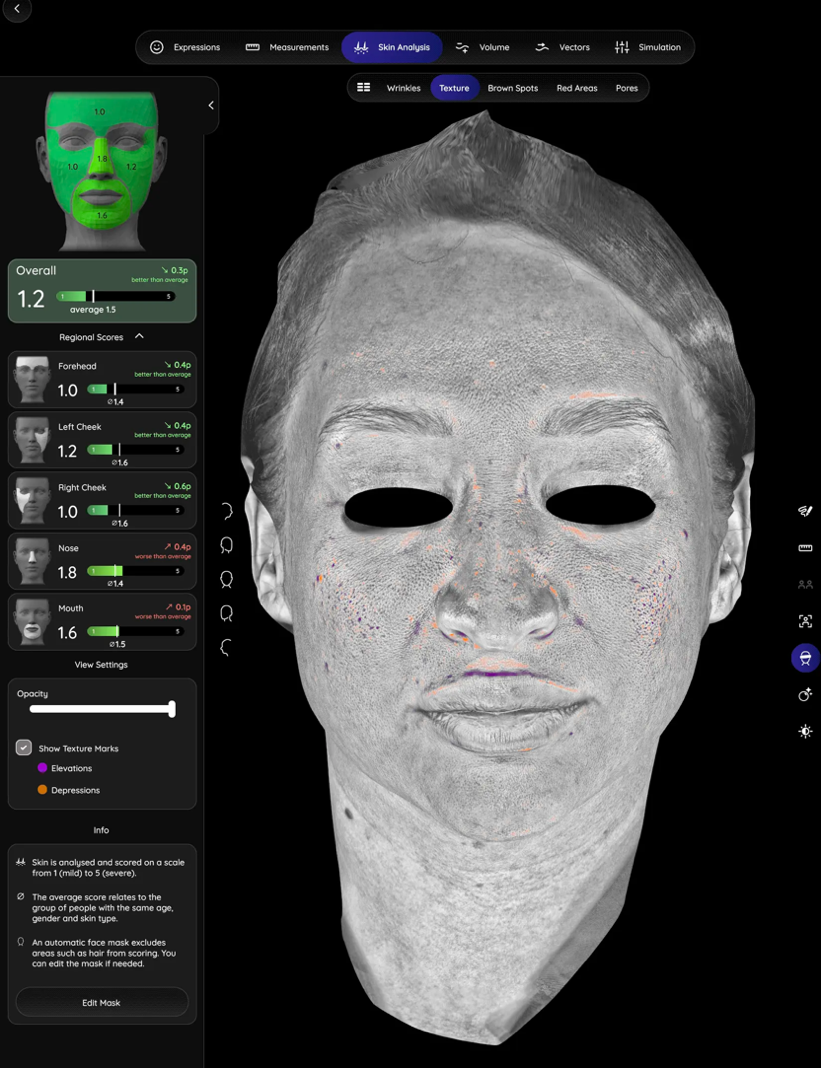
- Skin texture, captured at a fine surface level
- Facial proportions, angles, and distances, which inform treatment planning
This isn’t just marketing language. Aura received the iF Design Award in 2025, and its analysis features have reportedly been refined in collaboration with practicing dermatologists. The PMFA Journal has written about how Aura creates a “shared visual language” between provider and patient, a theme worth exploring further.
The Aura Consultation Experience at Revival Dermatology
Technology is only as good as the experience built around it, and this is where Revival’s boutique, family-owned approach matters. The process begins simply: a patient sits in front of the Aura device, hair pulled back, neck exposed, and the scan completes in under a minute.
What happens next is the heart of the experience. The provider sits down with the patient to walk through the results together in a 15 to 20 minute consultation that feels less like a traditional exam and more like a conversation between two people looking at the same evidence. The patient sees their own 3D facial map, zooming into pore structure, pigmentation patterns, and proportions mapped out in front of them.
As one clinical account in the PMFA Journal describes it, imaging systems like Aura help create a shared visual language between providers and patients.
“Aura turns a routine skin check into a visual conversation, helping patients see exactly what their provider sees.”
This is not a high-volume, assembly-line clinic experience. Revival Dermatology is family-owned and boutique, and that identity shapes every part of the Aura consultation. For anyone searching “dermatologist Dallas“ or “skin analysis Dallas“ and looking for a practice that balances advanced technology with a personal touch, this is exactly the combination Revival has built its process around.
Why Precision Imaging Matters for Treatment Planning
Precision imaging changes the quality of information available to both provider and patient, and that improvement has real downstream effects on treatment planning and outcome tracking.
Certain pigmentation patterns and early vascular changes can be difficult to see consistently across different lighting or time points. Aura’s imaging reveals these details with a consistency that visual exams alone can’t replicate.
This matters especially for treatments related to facial volume, laxity, or balance. Aura’s ability to measure proportion, angle, and distance means a provider can approach filler placement or a volumizing treatment like Sculptra with specific measurements in hand, rather than relying solely on visual judgment.
Perhaps the most practically valuable application is tracking results over time. Because Aura captures standardized imaging at each visit, providers can generate genuinely objective before-and-after comparisons rather than relying on memory or general impressions. Many effective treatments produce slow, steady improvement that’s hard to notice day to day, even when real progress is happening.
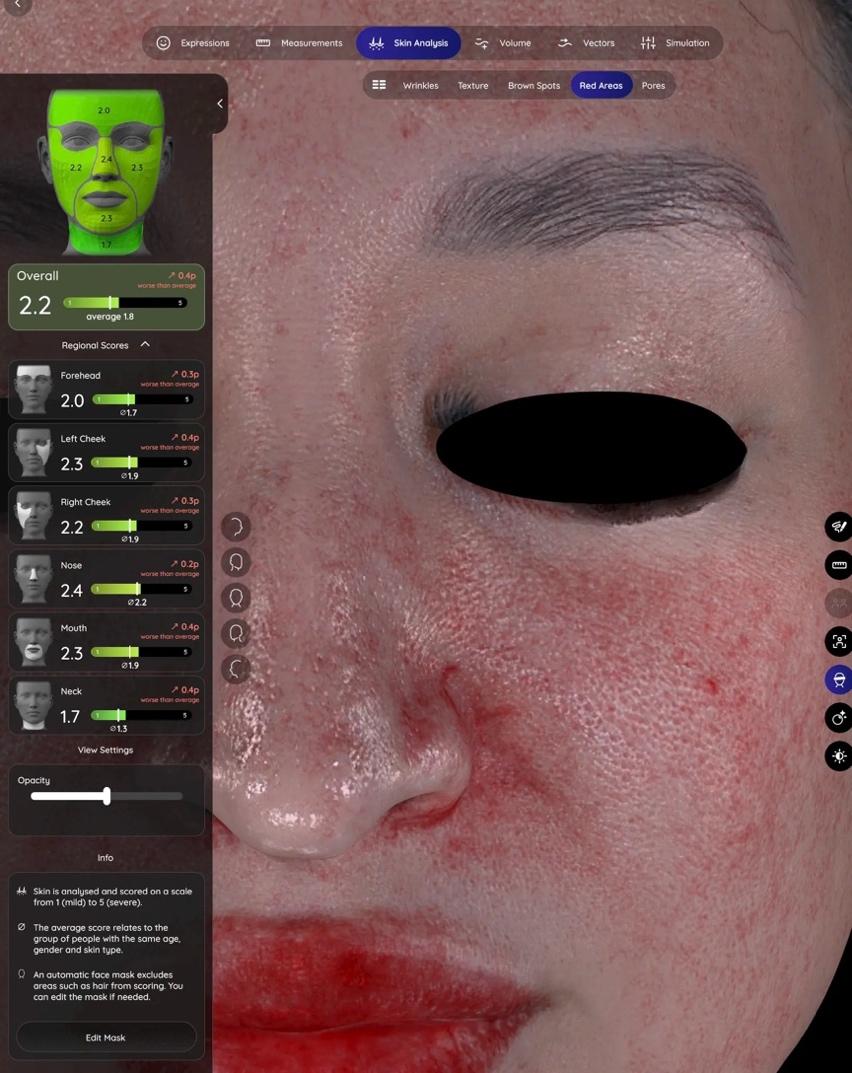
Consider a patient treating sun damage and uneven texture over several months. With documented, data-backed imaging at each stage, the patient can see in concrete terms that brown spots have measurably faded or texture metrics have genuinely improved. That documentation builds confidence that a treatment plan is working.
This is also where “shared visual language” becomes clinically significant rather than just a nice phrase. When provider and patient look at the same objective data, there’s far less room for miscommunication or misaligned expectations, which strengthens trust and long-term treatment adherence.
It’s worth noting that this kind of facial skin analysis doesn’t evaluate concerns in isolation. Texture, redness, and pigmentation are tracked together, because skin conditions rarely exist independently. A patient with rosacea, for example, may also show early sun damage that would otherwise go unaddressed if only the most visible concern were treated.
Who Benefits Most from Aura 3D Skin Analysis
A common misconception is that advanced skin imaging is only relevant for patients pursuing cosmetic treatments. In reality, the value extends across a much wider range of patients, aligning with Revival’s philosophy of serving patients of all ages and concerns.
Consider the patient noticing new brown spots and wanting to understand what’s happening: sun damage, early hyperpigmentation, or something else. Aura offers an objective starting point rather than a guess. The same is true for patients noticing persistent redness who may be dealing with early-stage rosacea.
Adults 35 and older beginning to notice volume loss or subtle shifts in facial proportion benefit from precise measurement when considering treatments like Sculptra or filler planning, where the goal is natural-looking, well-balanced improvement. Patients considering resurfacing or skin-tightening treatments like Halo or Morpheus8 also benefit, since these treatments produce gradual, cumulative improvement that’s hard to appreciate without consistent imaging to make progress visible.
It would be a mistake to assume this technology is only for patients actively seeking treatment. Many patients, including teenagers and younger adults, are simply curious about their skin’s condition and want to be proactive. For this audience, an Aura scan functions as an educational experience, helping build healthy habits early.
In short, an Aura-powered skin analysis is worth exploring if you’ve noticed new or changing brown spots or redness, are beginning to notice volume loss or proportion changes, are already pursuing resurfacing treatments and want documented progress, are simply curious about your skin’s condition, or have searched “skin analysis near me“ or “VISIA skin analysis near me“ and want to understand how a higher-resolution, Swiss-engineered alternative compares.
Aura vs. Traditional Skin Analysis: What Makes 3D Imaging Different
Many patients have some familiarity with photographic skin analysis machines, which commonly rely on 2D or multi-spectral photography and have genuinely helped countless patients understand their skin. The more useful question is what additional dimension 3D imaging adds on top of that foundation.
Because Aura builds a full 3D digital twin rather than a flat image, it adds facial geometry, proportion, angle, distance, and volume tracking directly on top of standard skin surface analysis, a model that can be rotated, examined from multiple angles, and compared precisely against future scans.
The Swiss engineering and Hexagon measurement heritage is a meaningful differentiator, underpinning Aura’s 0.1 millimeter accuracy as validated through Aura’s own technical documentation and refined specifically for clinical use in collaboration with dermatologists.
The underlying goal of any skin analysis technology, 2D or 3D, is the same: giving providers objective data to guide a personalized treatment plan rather than relying on visual assessment alone. Aura’s advancement isn’t that it replaces that purpose, but that it expands the depth and dimensionality of the data available to achieve it.
Frequently Asked Questions About Skin Analysis at Revival Dermatology
What is a skin analysis?A skin analysis is a diagnostic look at both the surface and underlying condition of the skin, evaluating pigmentation, texture, vascular activity, and wrinkles to guide a personalized treatment plan. At Revival Dermatology, this is performed using the Aura 3D imaging system.
What is VISIA skin analysis?VISIA is one of the most widely recognized photographic skin analysis systems used across dermatology practices, generally relying on 2D and multi-spectral photography. Revival’s Aura system builds on that same core concept but distinguishes itself through its Swiss-engineered, 3D imaging approach, adding facial geometry, proportion, and volume measurement on top of traditional skin surface analysis.
Are skin analysis machines accurate?Aura’s analysis features have been developed and refined in collaboration with dermatologists to help confirm their accuracy for clinical use. That said, no imaging system replaces a provider’s clinical judgment; the data is meant to support and inform it.
How much does VISIA skin analysis cost?Pricing for photographic and 3D skin analysis varies by practice. Some offices include it as part of an initial consultation, while others apply the cost toward a future treatment. Contact Revival Dermatology directly for current consultation details.
What is the first step in a skin analysis?At Revival, the process begins with a brief, comfortable capture using the Aura system, completed in under a minute. The provider then walks through the results together with the patient during a 15 to 20 minute consultation.
Why is skin analysis important?A thorough skin analysis gives patient and provider an objective, data-backed starting point for treatment planning rather than relying solely on visual impressions, and allows for consistent before-and-after tracking, valuable for treatments where improvement happens gradually.
Bringing Clarity Back to the Mirror
This article began with a familiar moment: standing in front of a mirror, wondering what your skin actually needs, with no reliable way to answer that question. That uncertainty is exactly what Aura was built to resolve. By combining Hexagon’s precision measurement engineering with a thoughtful, patient-first consultation process, Revival Dermatology has created a genuinely honest, data-backed starting point for any skincare journey.
What makes this especially meaningful is the environment this technology lives in. Aura’s precision isn’t deployed inside a high-volume, transactional clinic. It’s used inside a family-owned, boutique dermatology practice where providers take the time to sit down, explain findings clearly, and treat every patient as an individual. That combination, serious clinical precision paired with genuine personal care, reflects Revival Dermatology’s broader value of blending a deep passion for dermatology with real compassion for every patient who walks through the door.
For anyone who has ever left a dermatology appointment with more questions than answers, or who has simply been curious about what their skin would reveal with the right technology behind the analysis, there has never been a better time to find out. Revival Dermatology invites you to experience your own Aura 3D skin analysis firsthand. Come see, in precise, measurable detail, exactly what your provider sees, and leave with a personalized, data-backed plan built specifically around your skin.
Ready to see your skin clearly for the first time? Book Appointment with Revival Dermatology today.